Chalong Krung Road, Lat Krabang Flood 2026: A Real Case of Lingering Water, the Germs It Carries, and How to Disinfect with Chemgene HLD4H
Last updated: 5 Oct 2026 | 10 Views |
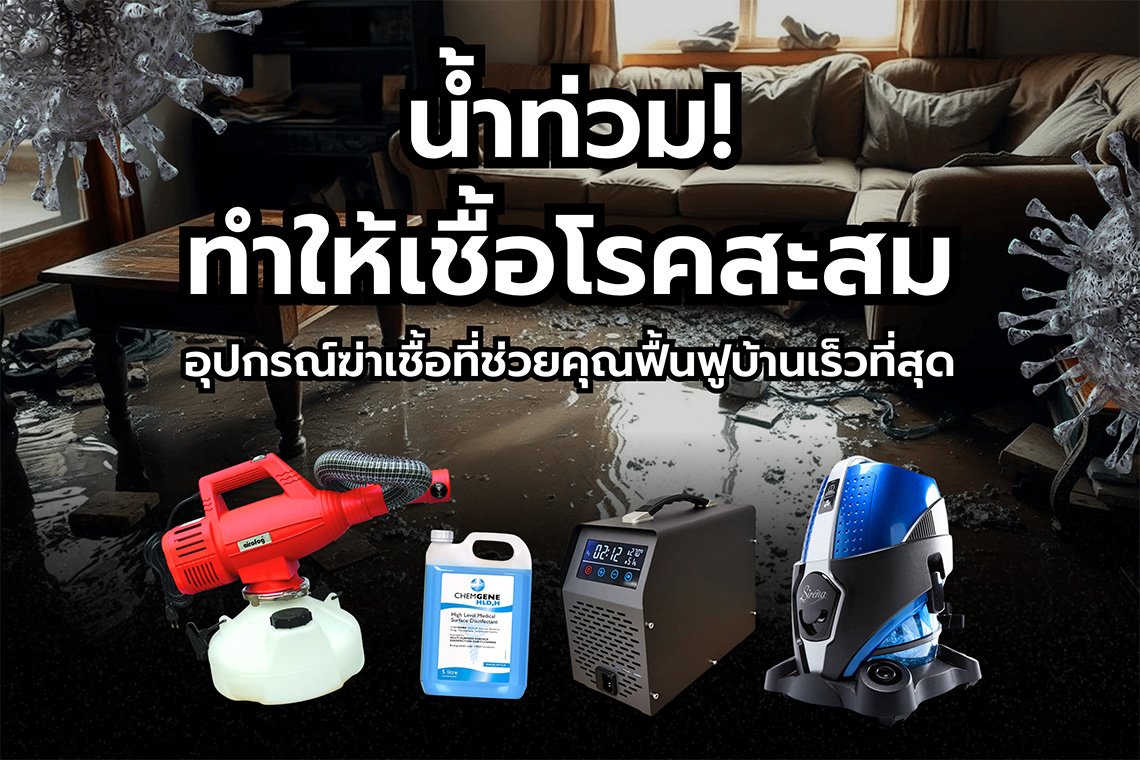
Chalong Krung Road, Lat Krabang Flood 2026: A Real Case of Lingering Water, the Germs It Carries, and How to Disinfect with Chemgene HLD4H
If you drove, rode a motorbike, or took a bus along Chalong Krung Road in Bangkok's Lat Krabang district in the first days of October 2026, you probably saw the same scene thousands of other commuters saw: a main road still sitting under murky water, wheels pushing small waves toward the pavement, and shopfronts guarded by sandbags that had been in place for days. The worst of the rain had passed at the end of September, yet the water on this road had not gone.
This article retells the real, reported case of the Chalong Krung Road flood in 2026 exactly as the media described it, without adding numbers, names or quotes that were not reported. Then it looks at what this kind of standing urban floodwater carries into homes, shops, factories and cars, who is most at risk, why soap or bleach alone often falls short, and how to finish the clean-up properly with the medical-grade disinfectant CHEMGENE HLD4H, step by step.
Note: water levels and household figures change daily. Always check the latest announcements from the Bangkok Metropolitan Administration (BMA) and the Department of Disaster Prevention and Mitigation (DDPM).
What Happened on Chalong Krung Road, Lat Krabang
To understand this case, start with the bigger Bangkok picture. According to news reports, between 24 and 27 September 2026 the capital received around 300 mm of continuous heavy rain in roughly 48 hours. That volume overwhelmed the city's drainage, filled canals to their banks, and hit eastern Bangkok hardest.
On 26 September 2026 the BMA declared all 50 of Bangkok's districts a disaster zone, a city-wide declaration. A DDPM report dated 2 October 2026 put the number of affected households in Bangkok at around 329,000. That figure alone shows this was not a problem for a handful of neighbourhoods; it reached into the daily lives of a very large share of the city.
For Chalong Krung Road specifically, according to a Thairath headline on 5 October 2026, the BMA updated its list of flooded points on main roads and reported that Chalong Krung Road still had water about 15-25 cm deep. In other words, more than a week after the heaviest rain, and while many roads elsewhere had dried, Chalong Krung was still one of the places where water lingered.
Fifteen to twenty-five centimetres may not sound dramatic next to images of waist-deep water in the provinces. On a busy main road, though, it is enough to top kerbs, reach shop floors built close to street level, and, every time a truck passes, push a wave higher than the standing level into shopfronts, row houses and car parks. Just as important is time. Water that sits for days on a road lined with drains, manholes and communities has more and more opportunity to collect contamination.
Chalong Krung is a key artery of Lat Krabang, running past homes, shops, educational institutions and industrial areas. The people who use it are therefore very varied: factory workers heading to shifts, students, parents on the school run, vendors and delivery riders. All of them touch the standing water in some way, whether by wading, waiting for a bus, or simply bringing wet shoes, tyres and belongings back home.
What the reports do not tell us, and what we will not guess, is how many buildings on Chalong Krung took water inside or what each shop lost. What is confirmed is that on 5 October 2026 this road still had 15-25 cm of water, in a city where all 50 districts had been declared a disaster zone. That is enough to say residents and businesses should plan a serious clean-and-disinfect routine once the water drops.
Example Case: A Shophouse Kitchen After the Water Drops
(An illustrative scenario based on common situations, not a real person or business from the news reports.)
Picture "Toi", who runs a rice-and-curry shop in a two-storey shophouse on Chalong Krung. While the road stayed flooded she opened for half days, because her regulars, mostly shift workers, still had to eat. Each time a heavy truck went by, a brown wave washed over the sandbags and left a thin film of silt on the tiles, around the table legs, the chairs and the chest freezer.
When the water began to fall, Toi swept out the mud, hosed the floor and poured a scented floor cleaner over everything. By evening the shop looked clean. Two or three days later, a musty smell crept back from under the freezer and from the tile grout. The cloths that had soaked in floodwater still smelled after washing, and one of her staff developed diarrhoea, which could have many causes but made Toi wonder whether "looking clean" and "being disinfected" were really the same thing.
The same story repeats in row houses, ground-floor condo units, student dormitories, motorbike repair shops and worker housing anywhere street water once flowed inside. The problem is rarely effort. It is the order of the steps and the tools used, which the next sections explain.
Which Germs Come with Standing Water on a Main Road Like Chalong Krung
Urban floodwater differs from rural river flooding because it passes through the city's infrastructure before it reaches you. Water on Chalong Krung can combine backflow from drains and manholes, roadside rubbish, oil from vehicles and waste from communities. The World Health Organization (WHO) and the US Centers for Disease Control and Prevention (CDC) both advise treating floodwater as contaminated with sewage and germs, even when it looks fairly clear.
1. Sewage bacteria: E. coli and Salmonella
When drains back up onto the road surface, gut bacteria from people and animals come with them, including E. coli and Salmonella. They can cause diarrhoea, stomach cramps, nausea, vomiting and fever. After floods the usual routes are hands that touched wet floors or belongings and were not washed before eating, poorly cleaned dishes, and kitchen surfaces that floodwater reached. For a roadside food shop like the example above, this is the first risk to tackle.
2. Leptospirosis
Thailand's Department of Disease Control warns every flood season about leptospirosis. The bacteria are shed in the urine of rats and other animals, survive in standing water and mud, and enter through cuts, scrapes or skin softened by long soaking. Big cities have large rat populations in drains and rubbish piles; when drains flood, rats move up, so standing water on roads is more likely to be contaminated. Watch for sudden high fever, headache and muscle pain, especially in the calves, after wading. Anyone with these symptoms should see a doctor promptly and mention the flood exposure.
3. Viruses spread by surfaces and crowding
After floods people live more closely together: belongings move upstairs, families share one room or stay with relatives. Damp air and wet surfaces help some viruses spread. Ones worth knowing are norovirus and rotavirus, which cause severe diarrhoea particularly in children; hand-foot-and-mouth disease virus, which spreads among young children through shared toys and surfaces; and respiratory viruses such as RSV and influenza, which are already common in the rainy season. These can sit on door handles, stair rails, tables and toys, which is why disinfecting shared touch points matters as much as removing mud.
4. Mould and musty odours
Shophouses and commercial buildings along main roads are often closed-in with little airflow. When plaster walls and plywood absorb water, mould can start within days. The CDC advises cleaning and drying as quickly as possible, ideally within 24-48 hours after the water recedes, to limit mould. On a road where water lingered for days, many buildings could not meet that window. Mould brings black stains and musty smells, and it can trigger allergies, asthma and respiratory irritation.
Who is most at risk in Lat Krabang
- People who wade to work every day, such as factory staff, riders and vendors, who are exposed repeatedly and may have small foot wounds they do not notice.
- Young children and students, who play in water, put hands in mouths and share toys.
- Older adults, whose immunity is lower and who slip easily on silty floors.
- Pregnant women and people with chronic illness, such as diabetes, kidney disease or immune suppression.
- Food-shop and stall workers, because a small cleaning lapse can pass germs to customers.
Remember: a disinfectant lowers the risk from germs on surfaces. It is not medical treatment. Anyone with fever, persistent diarrhoea or calf pain after wading should see a doctor.
The Cost Beyond Wet Floors: Health, Money, Time and Trust
Health. Flood-related illness often arrives not on the day the water peaks but while it is falling and everyone starts cleaning, because that is when contact with mud and wet belongings is highest. One person with diarrhoea or fever in a household can become the whole family within days.
Money. For shops on Chalong Krung, every closed day is lost income. Closing again because staff fall ill, or because customers doubt the hygiene, stacks a second loss on the first. In homes, throwing out mouldy furniture that was never properly disinfected and dried usually costs far more than the disinfectant would have.
Time. Many Lat Krabang residents work shifts, so time for cleaning is short. A rushed wash that has to be redone because the musty smell returns is time spent twice.
Trust. A restaurant, dormitory or business that can tell customers "we removed the mud and disinfected with a medical-grade product according to the label" wins back confidence faster. In a city that has just been declared a disaster zone, a feeling of safety is what customers want most.
Why Soap, Detergent or Bleach Alone Often Falls Short
First, soap and detergent are essential. They lift mud, grease and dirt, and no disinfectant works well on a surface still coated in silt. But soap is not designed to disinfect surfaces systematically. It carries some germs away with the rinse water, yet germs lodged in grout, joints and porous surfaces can remain.
Many households reach for bleach because it is cheap and easy to find. Used correctly it has its place, but it has limits worth knowing:
- Corrosion. Strong chlorine attacks metals such as stainless-steel table legs, freezers, roller shutters and aluminium frames, and can make some rubbers and plastics brittle, which are exactly the materials shops and factories rely on.
- Harsh smell and irritation. In poorly ventilated shophouses, chlorine fumes sting eyes and noses and are a problem for older people, children and anyone with respiratory conditions.
- Dangerous mixing. Mixing bleach with acidic toilet cleaners or ammonia can release hazardous gases. During a rushed post-flood clean-up, such mistakes are easier than people think.
- No lasting protection. Once chlorine evaporates, the surface is back where it started. If people keep walking in mud from a still-flooded road, the risk returns immediately.
That last point matters especially on Chalong Krung because, as of the 5 October 2026 report, the road was not yet dry. Homes and shops along it will keep receiving mud and water on shoes and tyres for a while, so a non-corrosive product with stated residual surface protection is more useful.
The Solution After the Water Drops: CHEMGENE HLD4H Medical-Grade Disinfectant
Once the mud is gone and surfaces are clean, the next step is disinfection, the job CHEMGENE HLD4H was designed for. According to the product information, CHEMGENE HLD4H is a medical-grade high-level disinfectant made in England and used in hospitals, clinics, laboratories, schools, offices, airports, homes, and elderly and child care settings.
Key points, according to the product information
- Listed as effective against bacteria, fungi and mould, mycobacteria, Salmonella and viruses including influenza H1N1, RSV, norovirus, hand-foot-and-mouth virus and SARS-CoV-2.
- The product page states it kills within 1 minute and is 99.85% effective against COVID-19.
- It states residual surface protection of up to 14 days.
- Flexible dilutions: 1:30, 1:50, 1:60, 1:100 and up to 1:200 depending on the task.
- Biodegradable, and non-corrosive to stainless steel, aluminium, rubber, plastic and fibreglass.
- The page says it is safe for people, pets and medical equipment when used as directed.
- Listed tests and approvals include Mahidol University, NHS England, ISO 9001:2015, ISO 13485, SGS, Intertek, CE, and EN 13727 / EN 14348 / EN 13624 / EN 14476.
For shops and row houses on Chalong Krung, two features matter most: it is non-corrosive, so it can be used on stainless freezers, roller shutters, aluminium frames, rubber mats and plastic furniture as directed; and its stated residual protection is useful while the road outside is still wet and fresh mud keeps arriving.
How to Use Chemgene After the Chalong Krung Flood, Step by Step
The rule you must not skip: remove the mud and wash first, then disinfect at the dilution and contact time on the label.
- Protect yourself. Wear rubber gloves, boots, a mask and eye protection when spraying in tight spaces. Switch off breakers for areas the water reached and have an electrician check before restoring power.
- Ventilate. Shophouses have few openings, so raise the shutter and run fans the whole time you work.
- Remove wet items and sort. Porous items soaked for long periods, such as mattresses, carpets, paper, cardboard and swollen plywood, are usually not salvageable. Hard, smooth items can be washed and disinfected.
- Shovel and sweep out the mud, working from the back toward the door so it does not circulate.
- Wash with clean water and detergent. Scrub floors, walls up to the waterline, table and chair legs and grout, then rinse.
- Dilute Chemgene HLD4H per the label, choosing a ratio within the 1:30 to 1:200 range given in the product information. Never mix it with bleach or other chemicals; use a clean, labelled container.
- Spray, wipe or mop over the cleaned surfaces, focusing on shared touch points: door handles, shutter handles, stair rails, counters, dining tables, light switches and entrance floors.
- Leave it for the contact time on the label. Do not wipe it off straight away; contact time is what makes disinfection work.
- Dry and air out, using fans or a dehumidifier to cut the chance of mould.
- Repeat in high-traffic spots. As long as the road outside is wet, clean and re-disinfect the entrance area as needed.
For surfaces that touch food directly, such as chopping boards, dishes and prep counters, follow the label's instructions on rinsing with clean water, and always keep the product out of children's reach.
10 Reasons Lat Krabang Homes and Shops Choose Chemgene HLD4H
- High-level, medical-grade disinfectant made in England and used in hospitals, according to the product information.
- Covers the germs urban floods bring: bacteria, Salmonella, diarrhoea viruses such as norovirus, and mould, in one product.
- Works fast. The product page states it kills within 1 minute, useful for people squeezing cleaning between shifts.
- Stated residual protection of up to 14 days, helpful while Chalong Krung still has standing water and mud is tracked in. See product details
- Non-corrosive to stainless steel, aluminium, rubber, plastic and fibreglass, protecting the equipment shops and factories earn a living with.
- Flexible dilution from 1:30 to 1:200 for heavy jobs and daily wipe-downs alike, which makes each litre go further.
- Biodegradable, kinder to the environment when rinse water goes into city drains.
- Safe for people and pets when used as directed, according to the product information, suitable for homes with children and older adults.
- Multiple tests and approvals, including Mahidol University, NHS England, ISO, SGS, Intertek, CE and EN standards. See certifications
- No harsh chlorine smell, so working inside a closed shophouse is more comfortable and customers do not walk into a chemical cloud.
Before and After: A Shophouse on Chalong Krung
Before (water and detergent only)
- Floor looks clean but grout stays dark
- Musty smell returns within days
- Rust spots on stainless legs after strong bleach
- Entrance re-soiled every time someone walks in
- Staff and customers still uneasy about hygiene
After (wash, then Chemgene)
- Every surface washed, then disinfected per label
- Musty smell reduced alongside proper drying
- Metal fittings not corroded
- A routine for disinfecting the entrance
- Shop can say clearly it uses a medical-grade product
Disinfection Checklist for Homes, Shops and Dormitories on Chalong Krung
While the road is still flooded
- Set up a shoe-change spot at the door; keep wading shoes apart from indoor shoes.
- Wash hands with soap after coming home, before touching food or holding children.
- Clean and disinfect door handles, shutter handles and switches daily.
- Cover cuts on feet and legs with waterproof plasters; never wade barefoot.
- Check the BMA's flooded-road updates before leaving home.
The day the water leaves your doorstep
- Photograph damage before cleaning, in case you apply for assistance.
- Have the electrics checked before switching breakers back on.
- Shovel mud, wash with detergent, then rinse, in that order.
- Disinfect with Chemgene HLD4H at the label dilution and contact time.
- Run fans or a dehumidifier continuously to speed drying.
The following week
- Check for mould on lower walls, under cabinets and behind furniture.
- Re-disinfect shared touch points and the entrance.
- Watch family members for fever, diarrhoea or calf pain, and see a doctor if they appear.
- Food businesses: check freezers, dishes and prep areas before reopening fully.
For Factories and Workplaces in Lat Krabang
Lat Krabang is home to many businesses and industrial areas. Even where buildings are raised or protected, thousands of workers still travel through flooded roads and carry mud on shoes, clothes and vehicles into the workplace every day. The risk points are not only ground floors that took water, but entrances, changing rooms, canteens, toilets and staff shuttle buses.
A practical approach is to define clean and dirty zones, put a boot-wash point at entrances, clean and then disinfect shared touch points on a per-shift schedule, and disinfect inside shuttle buses, including grab rails, seats and floors, after the mud has been washed off. Because Chemgene HLD4H is described as non-corrosive to metals and rubber, it can be used on equipment and vehicles as directed without worrying about rust or material damage.
Worker dormitories and rental rooms nearby deserve the same care, especially ground-floor rooms where street water may seep in, shared bathrooms and laundry areas. Landlords who disinfect common areas systematically help limit the spread of germs among tenants who live closely together.
Frequently Asked Questions
Q: Is Chalong Krung Road still flooded?
A: According to a Thairath headline on 5 October 2026, the BMA reported that Chalong Krung Road still had water about 15-25 cm deep. Conditions change daily, so check the BMA's latest update before travelling.
Q: Is 15-25 cm of water really worth disinfecting after?
A: Yes. Risk depends not only on depth but on what the water contains and how long it stayed. Main-road water that sits for days is likely to include drain water and sewage, so every surface it touched should be washed and then disinfected.
Q: Can Chemgene replace mud removal?
A: No. Always remove mud and wash first. Disinfectant works on clean surfaces; poured over mud, it never reaches the germs underneath.
Q: Can I use it on a stainless freezer and a roller shutter?
A: According to the product information, CHEMGENE HLD4H is non-corrosive to stainless steel, aluminium, rubber, plastic and fibreglass, so it can be used on these materials as directed.
Q: What dilution should I use?
A: The product information lists 1:30, 1:50, 1:60, 1:100 and up to 1:200. Choose by task and follow the label. If unsure, call 065-556-6294 or message LINE @whd268.
Q: I have a toddler and a cat. Is it suitable?
A: The product page says it is safe for people and pets when used as directed. Keep children and pets away while spraying and until surfaces are dry, and store the product out of reach.
Q: What if I get a fever after wading?
A: See a doctor right away and mention the flood exposure, especially with high fever, headache or calf pain, which can signal leptospirosis. Disinfectant protects surfaces; it is not a medicine.
Ready to Disinfect Your Home or Shop After the Chalong Krung Flood?
Finish the mud clean-up, then seal the job with the medical-grade disinfectant hospitals trust.
Call 065-556-6294 · LINE @whd268 · worldhealthdisinfection@gmail.com
Related Links and References
- All Chemgene products
- WHD professional disinfection service
- Residential ozone disinfection service
- Thairath (5 Oct 2026): BMA update on flooded main roads
- World Health Organization: WHO fact sheets
- CDC: Floods and your health
- Department of Disease Control, Thailand: ddc.moph.go.th
Situation details follow news and DDPM reports as of the dates stated; figures may change daily.
#Chemgene #Disinfectant #MedicalGradeDisinfectant #ThailandFloods2026 #PostFloodDisinfection #LatKrabangFlood #ChalongKrungRoad #BangkokFlood2026
Keywords: Chalong Krung Road flood 2026, Lat Krabang flood, post-flood disinfection, medical-grade disinfectant, Chemgene HLD4H, Bangkok flood 2026, cleaning a shop after a flood, flood-borne diseases


