Disinfecting Retail Shops, Minimarts and Corner Stores After the Flood: Protecting Stock and Shelves in Bang Pakong, Chachoengsao (2026)
Last updated: 12 Oct 2026 | 7 Views |
Disinfecting Retail Shops, Minimarts and Corner Stores After the Flood: Protecting Stock and Shelves in Bang Pakong, Chachoengsao (2026)
A Field Story: The Day Jae Hong Rolled Up Her Shutter Again
Jae Hong runs a small family grocery store in a two-unit shophouse near the pier in Bang Pakong district, Chachoengsao. Her parents opened it decades ago, and it still sells a little of everything: rice, fish sauce, eggs, snacks, cold drinks, washing powder and household basics. Most of her customers are workers from the nearby industrial estates and neighbors in the soi who have known the family for years. This year the Bang Pakong River ran high just as heavy rain arrived, and floodwater came into the shop almost half a meter deep. It stayed for several days.
When the water receded, she rolled up the steel shutter and was hit at once by a wave of musty air mixed with the smell of wet cardboard and something sour from spoiled goods. The bottom shelf of every aisle was coated with mud. The corrugated boxes of stock in the back storeroom had gone soft and collapsed, and some already had white and green mold spreading across them. The steel shelf legs were starting to rust. There was water pooled at the bottom of the drinks fridge, and in one corner she found rat droppings and chewed snack bags.
Jae Hong and her daughter spent three days hauling out damaged goods, washing the floor, wiping shelves and running fans day and night. But every time they locked up at night and opened again in the morning, the musty smell was back. One regular walked in and asked, "Did your stock get wet, Jae?" Another picked up a bag of snacks, looked at it and quietly put it back. Jae Hong realized immediately that the problem was not only cleanliness. It was her customers' confidence.
Many retailers in Bang Pakong, Ban Pho and other riverside communities along the Bang Pakong River are facing the same thing during the 2026 floods. Small shops without their own hygiene team have to sort damaged stock, clean up and win back customer trust, all at the same time and usually with very little help.
Why a Flooded Shop Needs Serious Disinfection
A retail shop has features that make post-flood problems more complicated than in an ordinary home. There are many shelves with countless corners, enclosed storerooms with poor airflow, cardboard boxes that absorb moisture like a sponge, and products that customers pick up and handle all day long. Floodwater brings germs from drains, septic tanks and the street into the shop. When it drains away, those germs stay behind on the floor, shelves, walls and fridges.
A shop is also a closed space for most of the day and night. When the shutter is down, humidity builds up quickly, especially in Thailand's hot rainy season. That is exactly the environment mold loves. Within a few days of the water leaving, colonies can appear on cardboard, behind shelves, on the lower part of walls and around the seals of fridges and freezers.
The health risks
- Diarrhea. Bacteria from sewage, such as E. coli, can remain on shelves, shopping baskets, the checkout counter and product packaging, and then pass to customers' hands.
- Leptospirosis. Rats escaping the water come into shops looking for food and leave urine and droppings in shelf gaps and storerooms. Owners and staff who move stock without gloves are at real risk.
- Allergies and asthma. Mold growing on cardboard and walls releases spores into the air. People who work in the shop all day easily develop coughs, sneezing, a blocked nose or asthma flare-ups.
- Cross-contamination of stock. Goods that escaped the water but sit in a moldy room can pick up spores on their packaging and absorb a musty smell.
The business damage
Corner stores and minimarts survive on loyal customers and word of mouth. If a shopper walks in and smells mustiness, or notices mold in the corner of a shelf, the big convenience store chain down the road is always an easy alternative. The longer a shop stays closed or smells wrong, the more customers change their habits, and winning them back later is many times harder than keeping them in the first place.
The remaining stock is also the shop's working capital. If mold is allowed to spread from damaged boxes to good ones, the loss grows for no reason. Fast, thorough action protects both the shop's reputation and its money.
Why Ordinary Cleaning Falls Short in a Shop
1. Wiping shelves with bleach. Bleach kills germs where it touches, but the chlorine smell clings to products and packaging. It also speeds up rust on steel shelving and cannot reach behind shelves or under fridges.
2. Running fans all night. Fans dry the floor, but moisture in concrete walls, ceiling boards and the storeroom remains. Mold keeps growing quietly in the background.
3. Air freshener sprays and deodorizer blocks. These cover the smell for a short time, but customers then notice an odd perfume mixed with mustiness, which makes them feel something is wrong.
4. Painting over mold stains. Mold under fresh paint pushes through again within weeks, causing peeling and blotches, because the cause was never removed.
5. Restocking straight away. Bringing new stock into a room that still holds mold spores and bacteria risks contaminating fresh goods and repeating the whole problem.
A shop needs disinfection that reaches every corner, with a product that leaves no smell and does not corrode, together with mold and odor removal in the stock room. That is what WHD's service provides.
The Solution: Chemgene HLD4H Fogging Plus Ozone Treatment by WHD
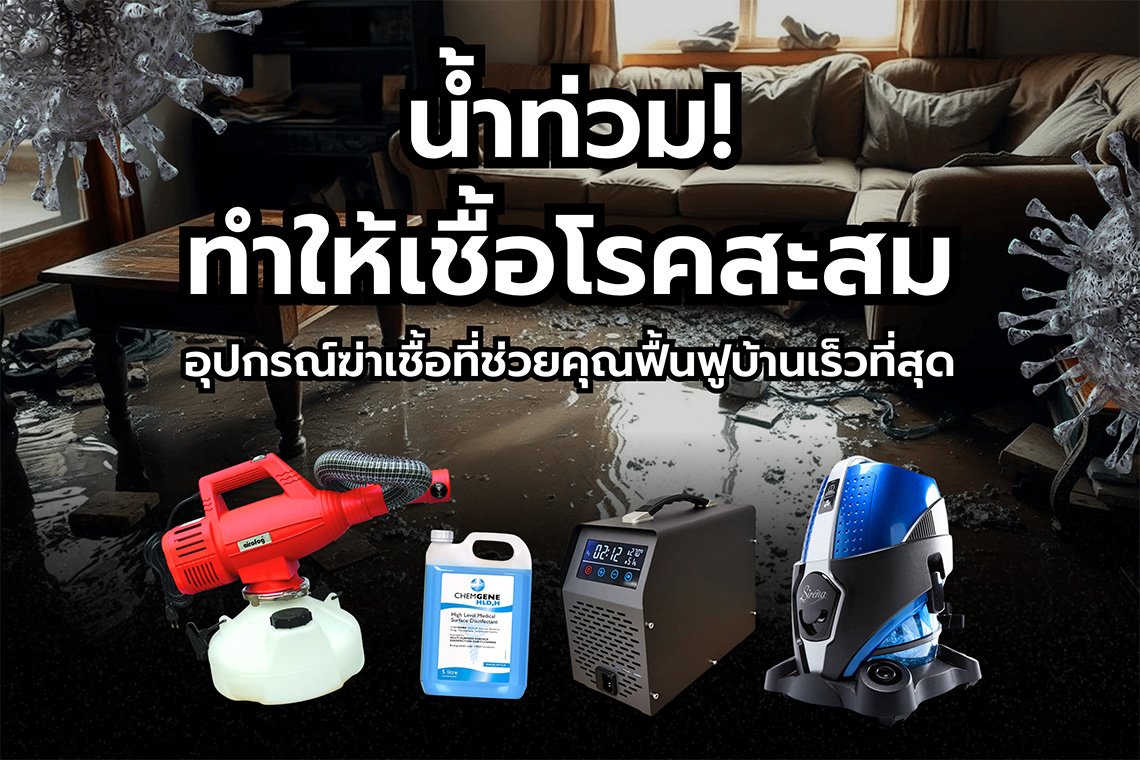
World Health Disinfection (WHD) provides professional disinfection fogging and ozone treatment for shops, commercial buildings and small warehouses. For a flooded retail store, we combine two technologies to deal with germs on surfaces and mold in the air.
Step one: fogging with Chemgene HLD4H
CHEMGENE HLD4H is a high-level disinfectant effective against bacteria, viruses and fungi. It contains no chlorine, does not corrode metal and leaves no harsh smell on products. We apply it with an ultra-low-volume (ULV) fogger so the fine mist reaches behind shelves, under fridges, into wall corners and around the checkout counter, places a cloth cannot reach.
Step two: ozone treatment for the stock room and shop floor
After closing time we use the Master Ozone Generator to treat the storeroom and the sales floor. Ozone is a gas with very strong oxidizing power. It penetrates hidden spaces, destroys mold and bacteria and breaks down musty odor molecules. After ventilation it returns to ordinary oxygen and leaves no residue.
Our six-step service process
- Site survey. We check the flood level, shelving, storeroom, fridges, mold patches and signs of rats, and plan which areas to fog and which to ozone treat.
- Stock sorting and initial clean-up advice. We help you decide which goods must be thrown away and which can be moved out or covered during the work, and advise on clearing mud before we start.
- Chemgene HLD4H fogging. We fog floors, shelves, walls, the counter, baskets, trolleys and the storeroom, allowing the full contact time.
- Ozone treatment. The shop and storeroom are closed and treated according to their size. No people, pets or plants may be inside.
- Ventilation. Doors and windows are opened until all ozone has dissipated before anyone re-enters.
- Re-check and advice. We check the smell and condition, then advise on storing stock off the floor and away from walls so mold does not return.
An important note about stock: Food and drinks that came into direct contact with floodwater should be thrown away. Disinfection fogging or ozone treatment cannot make contaminated food safe again. Our service is designed to make the shop space, shelves and storeroom clean and ready to receive fresh stock.
10 Reasons Bang Pakong Shops Choose WHD
- No smell left on products. Chemgene HLD4H has no chlorine odor.
- Kind to steel shelves and fridges. The disinfectant does not corrode metal.
- Reaches behind shelves and under fridges. The fine mist gets where hands cannot. See our disinfection service.
- Removes musty odor in the stock room. Ozone breaks down odor and mold. Read more about ozone odor removal.
- Protects the stock you still have. Lowers the chance of mold spreading to good boxes.
- Disinfects former rat areas. Reduces leptospirosis risk for owners and staff.
- Work after closing time. Open as normal the next day.
- Restores customer confidence. A clean, fresh-smelling shop brings regulars back.
- Stock storage advice. Helps prevent repeat problems next rainy season.
- Easy to reach. Call 065-556-6294 or LINE @whd268. We serve Bang Pakong, Ban Pho, Mueang Chachoengsao and nearby areas.
Before and After Fogging and Ozone Treatment
Before
- Musty air and wet-cardboard smell when the shutter opens
- Mud on the bottom shelves and rust on shelf legs
- White and green mold on stock boxes
- Rat droppings and gnawed packaging in corners
- Customers pick up goods and put them back
After
- The musty smell in the shop is clearly reduced
- Shelves, counter and baskets are disinfected
- The stock room is ready for a new delivery
- Former rat areas are treated, with prevention advice
- Regular customers come back with confidence
What Shop Owners Say
"We cleaned for three days and the smell was still there. The team helped me work out what had to go and what I could keep, then fogged and ozone treated the shop after closing. When I opened the next morning most of the musty smell was gone. My regulars said the shop felt fresh and clean, and I finally felt confident ordering new stock."
— Jae Hong, grocery store owner, Bang Pakong, Chachoengsao (field story)
In another case, Khun Thana, who runs a minimart near a workers' dormitory in Bang Pakong, had floodwater in his back storeroom that ruined cases of drinks and snacks. After throwing out the damaged stock and having our team fog and ozone treat the space, he rebuilt his storage on raised racks as we suggested and reopened soon afterward.
What Shop Owners Should Do After the Water Recedes
- Protect yourself. Wear rubber gloves, boots and a face mask whenever you move stock or clean.
- Photograph and list damaged goods. You will need this for insurance claims or local assistance programs.
- Throw away food that touched floodwater. Even if the packaging looks fine, do not sell it.
- Get wet cardboard out of the shop. Soggy boxes are a perfect breeding ground for mold and should go quickly.
- Have an electrician check wiring and fridges before switching them back on.
- Book fogging and ozone treatment before your next delivery arrives.
Once the shop is open again, simple daily care keeps it clean. Many owners keep a CHEMGENE HLD4H spray (750 ml) at the counter to wipe down the checkout, baskets and fridge handles every day. If the family home above the shop also flooded, our residential ozone disinfection can be done at the same visit.
Smart Stock Storage to Prevent the Next Flood Loss
Bang Pakong sits on a tidal river close to the sea, so high water can return in future rainy seasons. A few practical changes to how stock is stored can make a big difference next time.
- Raise your storage. Keep stock on racks or pallets at least a little above floor level rather than directly on the tiles. Even a short flood then affects far fewer boxes.
- Leave a gap from the walls. Boxes pressed against damp walls absorb moisture and grow mold first. A small gap lets air circulate.
- Use plastic crates for high-risk items. Rice, sugar and dry goods stored in sealed plastic containers survive damp conditions far better than cardboard.
- Rotate stock regularly. First in, first out keeps boxes from sitting untouched in dark corners where mold can start unnoticed.
- Prepare a flood plan. Decide in advance which goods move to the upper floor first and who is responsible, so you can act quickly when warnings come.
These steps cost little but protect your working capital, which for a small shop is often the difference between a quick recovery and a long struggle.
Rebuilding Customer Trust After Reopening
Customers rarely say out loud that they are worried about hygiene. They simply buy less, or go elsewhere. That is why it helps to be open about what has been done. A short handwritten sign by the door saying the shop has been cleaned, disinfected and ozone treated after the flood, and that all affected stock has been replaced, answers the question before anyone needs to ask it.
Keep the shop bright and airy for the first few weeks, put fresh stock at the front, and make sure the checkout area looks spotless. Small details like a clean counter and a freshly wiped fridge door tell customers more than any promise. For a neighborhood shop where people know the owner personally, honesty and visible care are the fastest way to get life back to normal.
It also helps to talk with your suppliers. Many distributors understand the situation after a flood and may be able to arrange smaller, more frequent deliveries while you rebuild your stock. Fresh deliveries arriving on clean, disinfected shelves send a clear signal to customers that the shop is fully back in business, and they help you avoid holding large amounts of stock while the building is still drying out.
Special Care for Drinks Fridges, Freezers and Ice Chests
Refrigeration equipment deserves extra attention after a flood. Drinks fridges and chest freezers sit directly on the floor, so floodwater often gets into the compressor area, the drain channel and the insulation around the base. Once the power returns, the warm, damp space behind the unit becomes a perfect home for mold and bacteria, and the fan can blow a musty smell straight back into the shop.
Before switching anything on, have a qualified technician check the electrical parts and compressor. Then empty the unit completely, remove shelves and drawers, and wash them separately. Pay close attention to the rubber door seals, where dirt and moisture collect in the folds, and to the drain hole at the bottom of the cabinet, which can be blocked with silt. Our team fogs the outside, underside and surrounding floor area with Chemgene HLD4H, and the ozone treatment of the shop helps deal with odor trapped around the back of the units.
If a fridge or freezer still smells strongly after cleaning, or if its insulation was soaked through, replacement may be the safer long-term choice. We will always tell you honestly what we see, so you can make the right decision for your business.
Keeping Owners and Staff Safe During the Clean-Up
In a small family shop, the people doing the heavy cleaning are usually the owner, relatives and one or two staff. Their health matters as much as the shop's. Lifting wet boxes, wading through mud and handling spoiled food all carry real risks in the days after a flood.
- Cover cuts and scratches with waterproof plasters before starting, and wear long rubber gloves.
- Wear closed rubber boots, never sandals, while standing in mud or water.
- Use a face mask when moving moldy cardboard, which releases clouds of spores when disturbed.
- Wash hands thoroughly with soap before eating, drinking or touching your face.
- Take breaks and drink clean water. Heat and exhaustion cause accidents.
- See a doctor quickly if anyone develops fever, muscle pain or red eyes after the clean-up, and mention flood exposure, since these can be early signs of leptospirosis.
Professional fogging and ozone treatment also reduce the time your family needs to spend in a contaminated space, which is another quiet benefit of bringing in help early.
Frequently Asked Questions
Q: Do I need to move all my stock out before fogging?
A: Not necessarily. Well-sealed goods can be covered, but fresh food, opened products and damaged stock should be moved out or thrown away. We will plan this with you after the site survey.
Q: Will ozone leave a smell on products or damage them?
A: Once the shop is ventilated, ozone breaks down into oxygen and leaves no smell. We set the treatment time appropriately and recommend moving certain items, such as fresh food, out beforehand.
Q: How long will my shop need to close?
A: We usually work after closing time, and the shop can normally reopen the next day once ventilation is complete. The actual time depends on shop size and the level of damage.
Q: Will Chemgene HLD4H make my steel shelves rust?
A: Chemgene HLD4H does not corrode metal, so it suits steel shelving and fridges, unlike chlorine products that can speed up rust.
Q: Can you get rid of rats as well?
A: Our service focuses on disinfecting areas rats have used, and we advise on sealing entry points and storing goods so rats have less to eat.
Q: Which areas do you serve?
A: Bang Pakong, Ban Pho, Bang Khla, Mueang Chachoengsao, parts of Chonburi, and Bangkok and its surrounding provinces. Call 065-556-6294 or message LINE @whd268.
Reopen With Confidence and Welcome Your Customers Back
Every day your shop still smells musty is a day customers might shop somewhere else. Contact World Health Disinfection today.
See Disinfection Service – Click Here
Book Ozone Treatment – Click Here
Call 065-556-6294 | LINE @whd268 | Email worldhealthdisinfection@gmail.com
Related Links
#ShopDisinfection #PostFloodDisinfection #OzoneTreatment #MustyOdorRemoval #MoldRemoval #DisinfectionService #ChemgeneHLD4H #BangPakong #Chachoengsao
Keywords: retail shop disinfection after flood, minimart flood cleanup, grocery shop mold, moldy shelves, musty shop odor, ozone treatment for shops, flood damaged stock, Bang Pakong, Chachoengsao, Thailand floods 2026


